“Have you ever just stopped, closed your eyes and used your feet to feel the world you stand on every day?”
Introducing Allwood Floors, a new line of hardwood flooring products that we have added to our catalog!
Their philosophy: To bring more than just beauty to your eyes – To bring beauty to your feet.
Their devotion: To bring the beauty that nature has given them, combining it with precise engineering to enhance that beauty – providing its customers with a floor so beautiful their eyes and feet will never be the same.
Allwood Floors is based out of Portland, Oregon. Allwood Floors are exotic real wood floors, with wood species from China, Indonesia, South America and Africa. Their manufacturing base in China is equipped with the “most advanced manufacturing facility and management team”. Allwood Floors are gaining popularity for their consistent quality, excellent service and competitive prices.
Allwood Floors initially started with 3-strip engineered maple and oak flooring, offering select, natural and rustic grades to satisfy the varied tastes of their customers. With the increase of demand, they added in single-strip in a variety of species and bamboo flooring in both engineered and solid.
They offer an incredible selection of wood species to choose from: Hickory, Brazilian Cherry, Bamboo, Red Mahogany, Maple, Red Oak, Sapele, White Oak, American Walnut, and Birch. Allwood Floors is bound to have something that fits into your budget and preferences including: three different grades: Natural, Rustic or Select; hand-scraped or not; solid or engineered; prefinished or unfinished.
“So whether you are standing in your black oxfords, or sliding down the hall in your socks, rest assure that Allwood has taken it all into consideration when they engineered the world beneath you.”
Visit GateWood Floors for more information and to see the wide selection of products we now offer by Allwood Floors!
Thanks to Allwood Floors, LLC. Images and information courtesy Allwood Floors, LLC.
Thursday, August 28, 2008
Introducing Allwood Floors!
| alternative flooring materials, bamboo flooring, eco-friendly, engineered wood flooring, flooring types, industry updates, new products, types and grades, wood, wood species Thursday, August 28, 2008
Monday, August 18, 2008
Radiant Heat & Wood Flooring: Part 2
| care and maintenance, contractor, diy installation, engineered wood flooring, hardwood floor basics, how-to, installation, moisture, radiant heat Monday, August 18, 2008A strange phenomenon occurring in radiant heat floors is color change directly over the tubes, typically happening with oily woods (often exotics). Over time, the difference in heat exposure directly over the tubes, compared to the rest of the floor, causes a color change in the warmer areas, usually darker, and reveals the exact pattern of the tubes. This is damage to your flooring that cannot be sanded out of the floor.
Before the wood flooring arrives at your job site, the radiant heat system must be running. How long depends on the moisture conditions necessary to bring the wood flooring inside. Some say 2 weeks, others say 30 days minimum. Turning the system on will ensure it is functioning properly, there are no leaks, and it is driving moisture out. If it is not turned on, and the subfloor sufficiently dried before the wood flooring is installed, it is a virtual certainty that when winter arrives, and the system is turned on for the first time, the wood flooring will cup and buckle as the moisture is driven out of the subfloor and into the wood flooring.
Once the flooring has been installed and it is time to apply the finish, it is important that prior to the finishing, the radiant heat is turned off long enough to allow time for the floor surface to reach a normal temperature, usually a minimum of 6 hours. If not, the entire floor will act like one big “hot spot”, similar to any spot where sunlight is directly hitting the floor. This will cause the finish to dry too fast, leaving applicator marks and causing bubbles. Once the finish is dry, the radiant heat can be turned back on.
Lastly, what happens after the installation is just as important as before and during. The environment must be maintained at optimal levels. Stabilizing humidity is the key. Whether that means adding moisture in winter or drier months or dehumidifying in summer or warmer months – this is critical to the success of the floor. Speak with you contractor to understand what the optimal environment is for your floor. Understand that even with humidity controls, it’s natural for wood floors to shrink and swell. It is also important that after being turned off for the season, the radiant heat is gradually turned back on. By its nature, radiant heat warms up slowly and it will be hard to resist the urge to turn it up higher and faster. This will cause a drastic temperature change for the floors and potentially irreversible damage. There are safeguards available to ensure this does not happen. Outdoor thermostats automatically and gradually turn radiant heat up or down in response to outdoor temperature changes. You should be educated by you contractor or installer as to how the heat works and why it shouldn’t be turned up too much at once. Finally, controls can be included in the system that prevent anyone from turning up the system too much at any one time.
For more helpful information on hardwood flooring options, or to buy the right flooring for your radiant system, please visit www.GateWoodFloors.com.
Friday, August 15, 2008
Radiant Heat & Wood Flooring: Part 1
| engineered wood flooring, hardwood floors, moisture, radiant heat Friday, August 15, 2008Wood floors are successfully installed over radiant heat every day. When deciding to install a hardwood floor over a radiant heating system, you will need to consider the experience of your installer, his understanding of the radiant heat system and his knowledge of the hardwood flooring being used, and most importantly – moisture. These variables need to be controlled or your dream floor will be a disaster.
Moisture is hardwood flooring’s most-feared and intimidating nemesis. Even without radiant heat, moisture is the leading cause of wood flooring problems. Add radiant heat, and the potential for moisture problems is exponentially increased because the radiant heat dramatically exacerbates the moisture fluctuations in a wood floor.
To understand better, some basic information about radiant heat may be helpful. Radiant heating consists of "radiant energy" being emitted from a heat source; this radiant energy (commonly known as
heat) then penetrates all objects in its path, including people. For example, the heat felt from the sun or fireplace is radiant heat. Radiant energy travels through a space without heating the space itself (unlike forced-air heating systems which actually warm the air). When radiant heat comes across a cooler surface (like a human being), it attempts to equalize the temperature difference, thus giving off heat. Most radiant heat systems used in the United States today are hydronic, meaning the subfloor has plastic tubes through which hot water flows. The water may be heated by anything from natural gas or electricity, to solar energy. A radiant heat system heats all the materials around it. In the process, it drys everything out, while driving moisture from the joists, slab, subfloor and flooring.
There are many product choices you can make to increase the chances of a successful radiant heat flooring installation. However, there are no guarantees.
• Quartersawn & Rift-sawn Floors: More dimensionally stable than plain sawn wood flooring. They expand in height, whereas, plain sawn boards expand in width.
• Narrower Boards: Shrink and swell less than wider boards. Less than 3” wide is recommended.
• Engineered Floors: More dimensionally stable than solid wood flooring. The more plies, the more stable the product.
• Reclaimed Woods: Have a tighter pattern of growth rings, making them more stable.
• Parquet: Less expansion and contraction tendencies.
• Dark floors: Darker colors make seasonal gaps in boards less noticeable.
• Floors with Obvious Grain Patterns: They also downplay the appearance of seasonal gaps between boards.
• Distressed Flooring: Minimize the appearance of seasonal gaps.
• Beveled Edges: Make seasonal gaps less obvious.
• Tongue and Groove Strips
• Dimensionally Stable Species: North American Oak, American Cherry, and American Walnut are known for their inherent dimensional stability. Species that are more dense, such as Beech, Australian Cypress, Maple, Brazilian Cherry, and some Bamboo products are less stable. Exotic species can be particularly susceptible to problems resulting from bad drying practices.
• Products made Specifically for Radiant Heat
In Part 2 of our series on Radiant Heat, we will talk about the best ways to stabilize your floor and avoid disaster.
For more helpful information on hardwood flooring options, or to buy the right flooring for your radiant system, please visit www.GateWoodFloors.com.
Monday, August 4, 2008
Bamboo
| alternative flooring materials, bamboo flooring, eco-friendly, engineered wood flooring, environmentally friendly, hardwood species, renewable resource, wood, wood species Monday, August 4, 2008
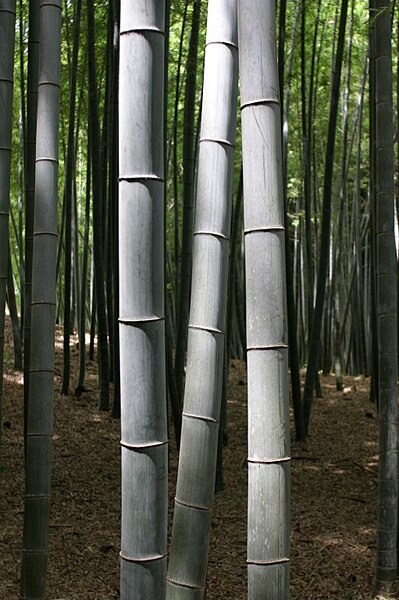
As one of nature’s most renewable gifts, bamboo has been used in many ways since the beginning of time. In modern times, it has become the wood of choice for making both decorative and practical items that are aesthetically pleasing as well as environmentally friendly. Bamboo will give you the natural beauty of hardwood flooring in your home without the detrimental effect on the environment. Bamboo is one of the hardest natural materials available for flooring use, and is an excellent alternative to tree wood, because of its extremely fast growth speed. Because bamboo is a rapid growing grass, and not wood, it can be harvested every 3-5 years, unlike 15-25 years for most tree wood, or up to 120 years for oak! Here are couple interesting facts about bamboo:
• It can also reach maximal growth rate exceeding one meter (40 inches) per hour for short periods of time
• 6 million people in China work in bamboo and 600 million people worldwide rely on income from it
Growth speed makes bamboo a very environmentally friendly product for flooring. When it’s harvested, it grows back – just like your lawn. But unlike your grass, bamboo is hard – 25% harder than red oak, but equally as strong. Bamboo is also blessed with colorful tones and distinctive grains. Such sustainability, strength and beauty are major reasons why bamboo has grown to become one of the most popular flooring choices in America.
Bamboo flooring is available in countless colors and styles, which will compliment any interior design. From ultra-contemporary chic, to a more traditional, classic style, natural bamboo flooring will give you a truly unique look.
With high sustainability and environmentally sound origins, bamboo flooring has become a great choice for those looking to decorate their homes or workplaces with the beauty of a wood floor while being environmentally conscious. Because of this, consumers are increasingly choosing to install bamboo flooring in place of traditional hardwood.
There is no question that bamboo is a renewable resource and has been recognized as a “green material.” Quoting Environmental Building News, “Environmentally, it’s hard to argue with a wood substitute that matures in three years, regenerates without need for replanting, and requires minimal fertilization or pesticides.”
Visit GateWoodFloors.com and check out our selection of bamboo. It’s one of the biggest selections you’ll find anywhere!
Wednesday, July 16, 2008
Hardwood Flooring is Eco-Friendly
| all-natural, eco-friendly, engineered wood flooring, environment, hardwood floors, reclaimed flooring, renewable resource Wednesday, July 16, 2008
The nature of trends is that they don’t last. However, rising concerns over environmental issues indicate that “being green” has surpassed the “trend” stage and has now become a way of life for many consumers. There is evidence of this in our grocery stores with organic and natural foods displays, on packaging for brand name products, advertising “all-natural” or “no hormones,” and in the wave of community recycling programs for everything from paper to children’s toys to furniture - not to mention the free-cycling sites on the internet. So it is now safe to say that "being green" is not a “trend." It is a movement.
The move to environmental responsibility has reached the hardwood flooring industry as well.
Hardwood flooring is, in itself, green. It’s green because it already has the potential to be timeless - used forever as long as it’s maintained properly. It’s made from all-natural renewable resources. Manufacturers around the hardwood flooring industry are making an even bigger push to create flooring products with less waste and longer life. For example, engineered hardwood flooring continues to gain in popularity with consumers. It is a preferred flooring option in most every residential sector. In response to this increasing demand, manufacturers are creating engineered flooring that provides solutions to contractors’ and consumers’ concerns associated with construction, styling, performance and installation. In addition to coming from managed forests, some of these new engineered flooring products are produced with up to two-thirds less harvested wood than with typical wood flooring options. Manufacturers are using the dense inner layers of wood fiber, which are created as by-products from the manufacturing of other products like sawmill by-products. Otherwise these fibers would be thrown away, burned or put into landfills. An example of this extremely eco-friendly product, that showcases unsurpassed structural integrity, impact resistance and moisture tolerance, is Shaw’s EnviroCore ™ - used in their Epic engineered hardwood collection.
We’ve come to a time where “what’s old is new again." And it’s becoming increasingly popular, and important. Reclaimed wood flooring manufacturers are turning old timbers into beautiful wood flooring. Consumers appreciate the reclaimed flooring for its character and time-worn look. And they feel good about choosing a floor with minimal environmental impact.
Whether you are buying new, refinishing old, or reclaiming and reusing, being aware of how your flooring decision effects the environment is important. As the move to go green continues, many hardwood flooring manufacturers will only continue to offer more options to their customers. And GateWood Floors will be here to guide you along the way.